
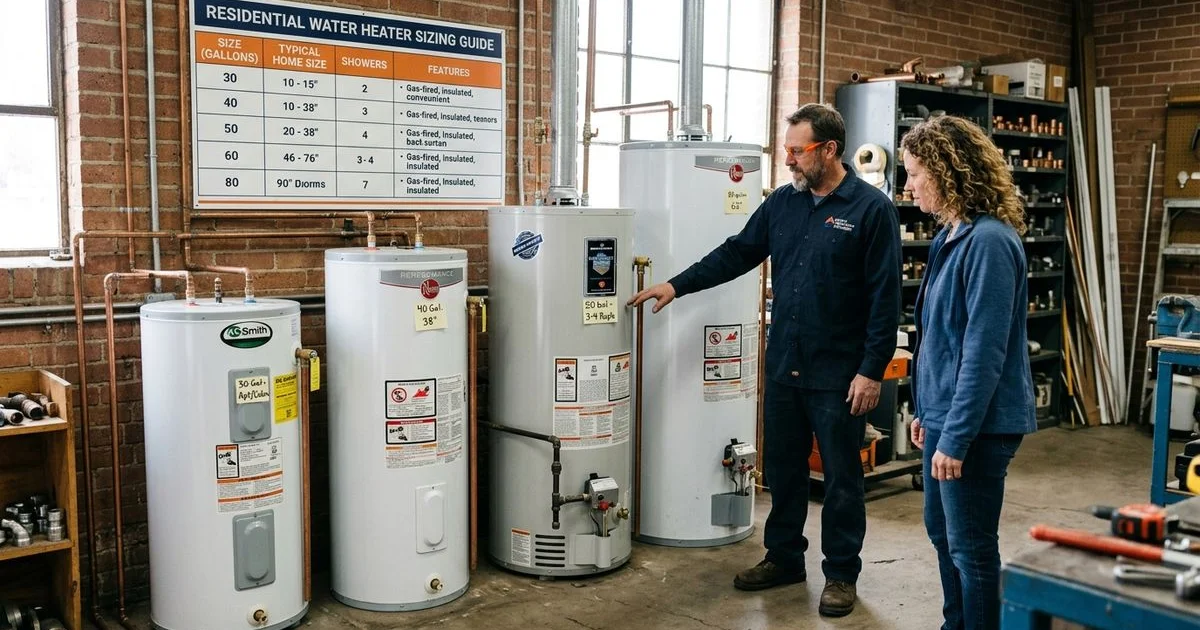
What size water heater do I need: Why sizing matters more than you think
You already know that buying a tank that is too small guarantees a cold shower. When homeowners ask us, “what size water heater do I need,” they often miss the financial penalty of going too big.
The U.S. Department of Energy released 2026 data showing water heating now accounts for roughly 18% of a home’s total energy use. That is a massive piece of your monthly utility pie.
We see the results of poor sizing every week at Arvada Pro Plumbing. An incorrectly sized system leads to two expensive problems:
- Paying to keep unused water hot on standby.
- Forcing a small unit to overwork and fail prematurely.
Proper water heater installation starts with securing an exact match for your usage. I am going to break down the calculations for both tank and tankless models so you can make an informed choice.
Tank water heaters: gallons and first-hour rating
Tank capacities are labeled in standard gallon sizes, such as 30, 40, or 50 gallons. The most critical number for sizing is actually the First-Hour Rating (FHR), which tells you exactly how much hot water the unit delivers during your busiest hour.
You can find the FHR printed clearly on the yellow EnergyGuide label of major brands like Bradford White and Rheem. This metric accounts for both the tank volume and how quickly the burner can reheat water as you use it. Federal efficiency standards now require tanks over 55 gallons to meet strict Uniform Energy Factor requirements. That means if you size up blindly, you might be forced into buying a more expensive hybrid heat pump model just to stay compliant.
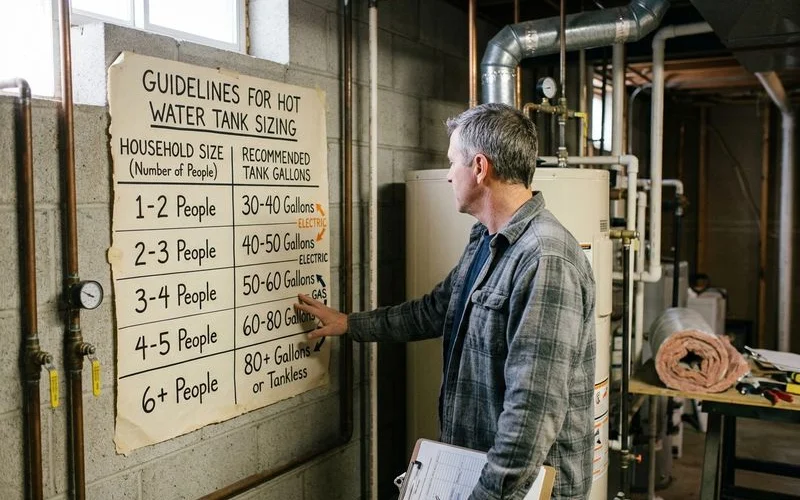
We recommend using household size as a baseline to determine your starting capacity.
| Household | Recommended tank size |
|---|---|
| 1-2 people | 30-40 gallons |
| 3-4 people | 40-50 gallons |
| 4-5 people | 50-65 gallons |
| 5+ people | 65-80 gallons |
Your daily habits dictate the final adjustment. Adding a large soaker tub or running simultaneous morning showers means you need a higher capacity. A home with strict low-flow fixtures and staggered shower times can comfortably drop down a size to save energy.
Tankless water heaters: gallons per minute
Tankless units heat water on demand instead of storing it. You must rely on maximum Gallons Per Minute (GPM) output at a specific temperature rise when determining your correct tankless water heater size.
The incoming groundwater temperature is the biggest variable in this equation. In Arvada, our winter groundwater temperatures frequently drop to a freezing 40 to 42 degrees Fahrenheit. You need a shower temperature of about 120 degrees, which requires a massive 80-degree temperature rise from the heater.
Our local climate significantly impacts system performance. A high-output 199,000 BTU unit from a premium brand like Navien or Rinnai might advertise 9 GPM on the box. That exact same unit will only produce roughly 4.0 to 4.4 GPM when fighting an 80-degree winter temperature rise.
Calculating peak GPM
You must calculate your peak demand by listing all the fixtures that might run at the exact same time. The EPA WaterSense program currently caps compliant showerhead flow rates at 2.0 GPM for 2026. If you have an older home built before 1994, your showerheads might still push 2.5 GPM and drain your system faster.
Here is a look at typical fixture flow rates:
- Standard shower: 1.5 to 2.5 GPM
- Bathroom sink: 1.0 GPM
- Kitchen sink: 1.5 GPM
- Dishwasher: 1.0 GPM
- Washing machine: 2.0 GPM (during the fill cycle)
- Tub fill: 4.0 GPM
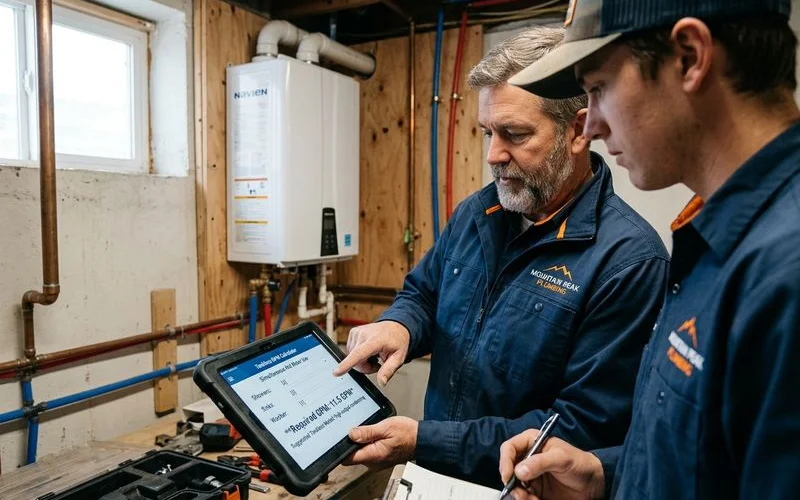
We frequently size systems for three-bedroom homes in Arvada where two showers and a kitchen sink run simultaneously. That scenario demands a peak flow of about 5 to 6 GPM. This calculation points directly to a high-output tankless unit to keep up with winter temperatures.
Larger properties with three simultaneous showers require 7 or more GPM. A demand that high usually requires two tankless units plumbed in parallel to maintain pressure and heat.
Fuel type considerations
Your choice of fuel dictates both the installation cost and your long-term utility bills. Proper water heater sizing requires looking closely at how these energy sources perform in real-world conditions. Natural gas units typically offer higher First-Hour Ratings and significantly faster recovery times than electric models.
Gas heaters cost more upfront, but Xcel Energy rate structures in Colorado generally show natural gas costs less per month than electricity. There is a specific catch for our region regarding gas combustion. Gas units face an altitude derating factor due to thinner air. At our elevation of over 5,300 feet, gas units lose roughly 20% of their heating capacity.
| Fuel Type | Upfront Cost | Operating Cost | Key Colorado Factor |
|---|---|---|---|
| Natural Gas | Higher | Lower | Loses 20% capacity at altitude |
| Electric | Lower | Higher | Unaffected by thin mountain air |
| Tankless (Gas) | Highest | Lowest | Requires 3/4-inch gas line upgrade |
We always factor in this altitude loss when calculating the required BTU output for a gas unit. Electric units bypass this oxygen problem entirely and require no exterior venting. This makes electric models easier to install in tight basement spaces, though they take longer to reheat a cold tank.
Upgrading to a tankless system requires verifying your home has adequate gas pressure. You will often need a 3/4-inch gas line instead of a standard 1/2-inch pipe to handle the rapid heating demand.
For a comprehensive breakdown of these options, read our tankless vs. tank water heater guide.
The most common sizing mistakes
The most frequent sizing error is buying a unit based solely on house square footage rather than actual water demand. A massive house with two occupants needs far less hot water than a smaller home with a family of five.
We see several recurring errors that lead to premature system failure and cold showers:
- Ignoring Arvada water chemistry: The U.S. Geological Survey classifies our local water as “very hard.” Just a quarter-inch of mineral scale reduces a heater’s efficiency by 25%, causing an undersized unit to overwork and die early.
- Sizing tankless on gallons: A tankless unit must be sized strictly on Gallons Per Minute (GPM), never on static volume.
- Forgetting the expansion tank: Colorado plumbing code requires a thermal expansion tank on closed plumbing systems to absorb excess pressure. Skipping this step stresses aging pipes and damages the unit, causing premature leaks.
- Underestimating peak usage: People frequently forget to calculate the washing machine and dishwasher running together during the morning shower rush.
- Ignoring winter temperatures: Failing to account for cold winter groundwater means your tankless unit will not keep up in January.
How we size on a real install
A professional sizing calculation evaluates your current fixtures, your daily schedule, and your home’s unique plumbing constraints. A contractor should never just pull the largest unit off the truck and hope it works.
Our team at Arvada Pro Plumbing conducts a thorough assessment on every visit. This evaluation covers three critical factors to ensure code compliance and performance:
- Inspecting water lines to accurately size the mandatory expansion tank.
- Calculating peak simultaneous demand based on your specific fixtures.
- Adjusting unit output to compensate for local altitude derating factors.
You get a recommendation that fits your actual lifestyle with a comfortable margin of error. We account for any planned remodeling, such as adding a high-flow soaker tub or a new bathroom addition.
Finding the perfect match for your daily routine is the only priority.
If you are wondering exactly what size water heater do I need for my specific house, contact us today to schedule a detailed home inspection.