
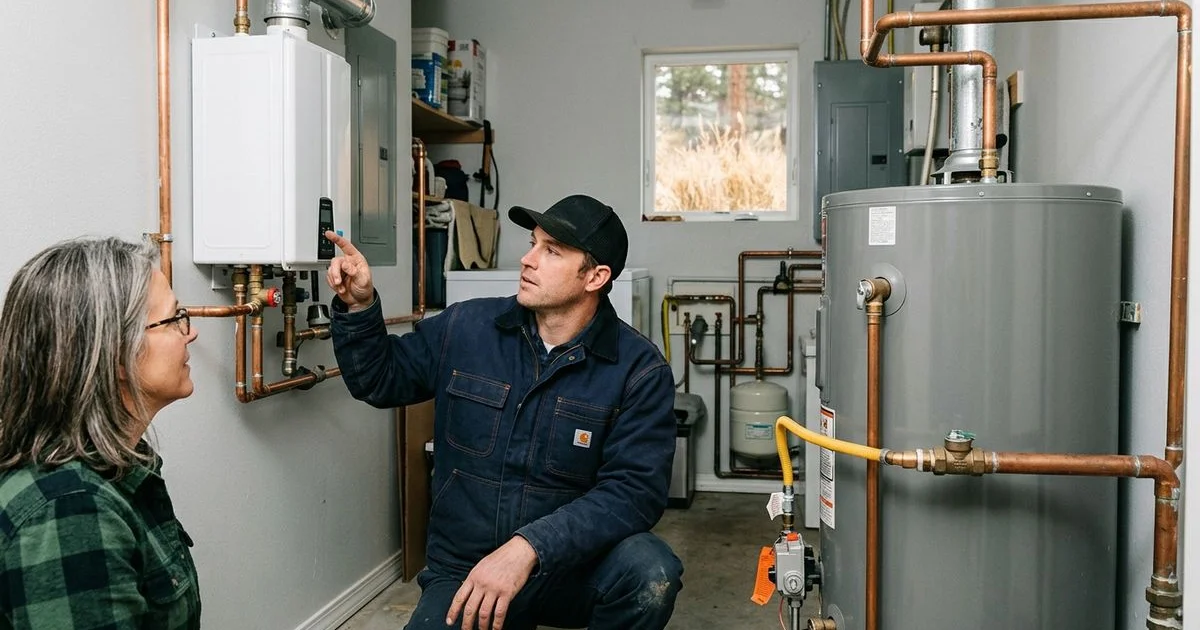
The tankless vs tank water heater debate is a conversation we have with Arvada homeowners every single week when they call for Tankless water heater service or general repairs. You know how frustrating it is when a major appliance fails unexpectedly.
Our team wants to clarify this discussion using the most current 2026 data for our local area. This choice usually boils down to weighing upfront costs against long-term energy savings.
We see that standard tanks currently run between $1,200 and $2,400 installed. Tankless units require a higher initial investment, starting around $3,500.
We will break down the main reasons this price gap exists and provide a practical framework to help you choose. A successful installation always depends on matching the right hardware to your home.
Our plumbers do not push one technology by default, ensuring you get an honest recommendation based on your actual infrastructure.
How each works
A tank water heater stores heated water continuously, while a tankless system heats water instantly on demand. Each method uses different internal technology to deliver hot water to your plumbing fixtures.
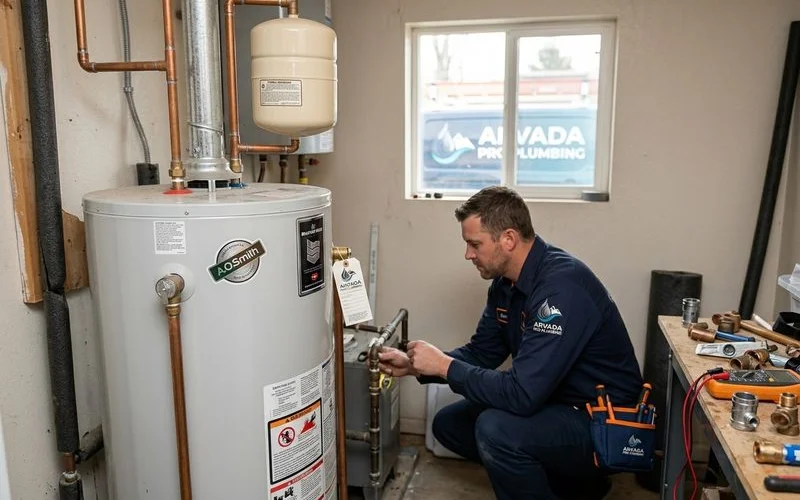
- Tank water heater: A storage tank holds 30 to 80 gallons and keeps that water hot continuously. When you draw hot water, fresh cold water enters the tank, and the gas burner or electric element re-heats it. Hot water is always ready for use, but the unit keeps water hot 24 hours a day whether you are home or not. This creates standby heat loss, which accounts for up to 15% of the unit’s total energy consumption. Our installers often recommend reliable brands like Bradford White because their 50-gallon tanks feature enhanced two-inch foam insulation to minimize this specific thermal loss.
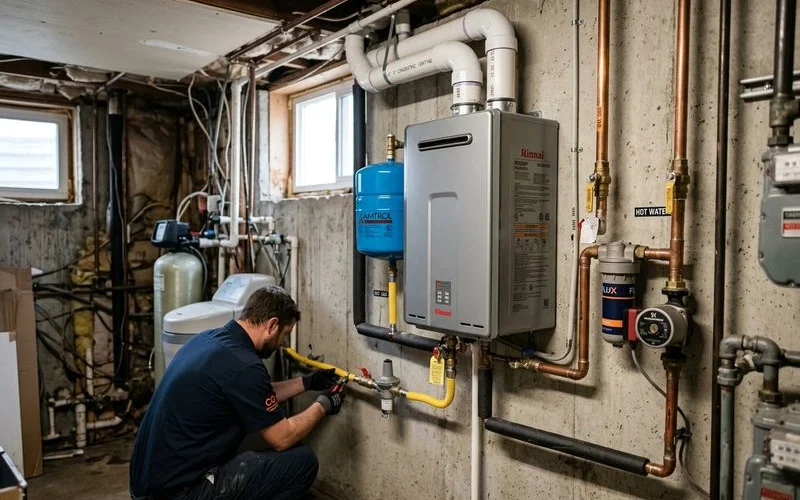
- Tankless water heater: These units have no internal storage capacity. When you turn on a hot water tap, a flow sensor activates the heating system, cold water flows through a copper heat exchanger, and you get hot water on demand. You experience no storage losses and no risk of “running out” of hot water, but the unit’s output is limited by its rated gallons per minute, or GPM, at your incoming water temperature. High-efficiency brands like Navien use condensing technology to capture exhaust heat, pushing efficiency above 95%.
Insider Tip: Check the minimum activation rate before you buy. Our technicians always warn homeowners that most gas tankless models require at least a 0.4 GPM flow to trigger the burner, meaning a slow trickle will not produce hot water.
Direct comparison
The upfront cost and projected lifespan are the two most significant differences between these systems. A standard tank offers a cheaper initial installation, while a tankless model provides longer-term energy value.
We created this data-driven comparison to help you evaluate the key metrics side-by-side. The numbers reflect current 2026 Arvada pricing and updated performance standards.
| Factor | Tank | Tankless |
|---|---|---|
| Upfront cost (installed) | $1,200 - $2,400 | $3,500 - $6,500 |
| Lifespan | 10-13 years | 15-20 years |
| Energy efficiency (UEF) | Standard (0.58-0.65) | Better (0.87-0.96) |
| Hot water “supply” | Tank capacity | Unlimited (within GPM rating) |
| Space required | 2 sq ft floor (40-gal+) | Wall-mounted, small |
| Recovery / re-heat | Time-based (depleted tank) | Continuous |
| Hard-water maintenance | Annual flush | Annual descaling required |
| Power outage | Gas works, Electric down | Both gas and electric down |
| Replacement install complexity | Like-for-like is straightforward | Often requires major upgrades |
When tankless wins clearly
A tankless water heater is the superior choice when you have high demand for sequential showers and plan to stay in your home long enough to see the return on investment. The higher upfront cost pays off over time through lower monthly gas bills and a much longer lifespan.
We see the greatest benefit from a tankless system under these specific conditions:
- Limited space. A wall-mounted unit fits in tight utility closets or crawlspaces where a bulky 50-gallon tank physically cannot go.
- High hot water demand. With proper sizing, a unit pushing 199,000 BTUs can easily handle three back-to-back showers without losing temperature.
- Long-term residence. The higher upfront cost pays for itself over 15 to 20 years, making it a smart permanent home upgrade.
- Energy bills matter. Standby heat losses on a traditional tank add up to roughly $40 to $60 a year in wasted gas.
- You want endless hot water. A tankless system allows you to fill a large soaking tub and run the dishwasher simultaneously without running out.
Our technicians always check the existing gas line size before recommending a tankless upgrade. Most older Arvada homes have a half-inch gas line, which must be upgraded to a three-quarter-inch line to support the massive BTU requirements of a tankless burner.
When a tank wins clearly
A standard storage tank is the most practical choice when your budget is tight or your home’s infrastructure cannot support high-demand gas lines. These units provide reliable daily performance with a much simpler and cheaper installation process.
We find that many homeowners prefer the straightforward nature of a conventional tank. You avoid complex retrofit costs while still getting excellent hot water delivery for daily tasks.
- Budget is the priority. A standard 40-gallon tank usually costs between $1,200 and $2,400 to install, keeping your initial expenses low.
- Moderate, predictable demand. A standard tank easily supports a typical household of two to four people with normal morning routines.
- You plan to move in the next 5 years. The tankless break-even point is usually seven to nine years out, so you will not see the return on investment if you sell soon.
- No electrical or gas line upgrades. Upgrading an electrical panel for an electric tankless unit often requires three 40-amp breakers, adding up to $2,000 to your bill.
- Simple maintenance preference. A standard tank flush takes about 30 minutes, whereas tankless descaling requires a specialized pump circulating a vinegar solution for nearly an hour.
Our crew can swap a standard tank in just a few hours with minimal disruption to your home. This makes it the ideal solution for emergency replacements when you need hot water restored immediately.
The Colorado-specific factors
Colorado’s freezing winter temperatures and mineral-rich aquifers drastically impact how any water heater performs. You must account for our specific groundwater temperature and local water hardness levels before choosing a new system.
We constantly remind clients that two local environmental factors hit harder here than in many other regions across the country:
- Cold incoming water in winter. Arvada groundwater can drop down to 45°F during January and February. Tankless units have to work incredibly hard to lift that frigid water up to a comfortable 120°F, which drastically reduces their maximum flow rate. A unit that delivers 7 GPM during a hot summer may only deliver 4 GPM in January.
- Hard water scale buildup. Arvada’s water hardness sits around 158 ppm, which equals about 9 grains per gallon of dissolved minerals. A standard tank requires an annual draining flush to remove loose sediment from the bottom. A tankless unit requires a chemical descaling process every single year to clear out its narrow heat exchangers.
We regularly replace ruined internal components because homeowners skipped this vital maintenance step. Skipping the annual flush on a tankless unit will dramatically shorten its lifespan and instantly void the manufacturer’s warranty.
Our team stresses that tankless maintenance is far more critical than conventional tank upkeep. Annual service guarantees your system will survive the harsh winter demand.
A practical decision framework
Making the right water heater choice requires evaluating your future timeline, household usage habits, and available budget. Use these specific questions to narrow down the best fit for your property and financial goals.
We recommend walking through this checklist before requesting an installation quote.
- How long will I be in this home? If you plan to sell in under 5 years, favor a standard tank. If you plan to stay over 10 years, favor a tankless system to maximize energy savings.
- What does my peak hot water demand look like? Multiple simultaneous showers require the continuous output of a tankless unit. Moderate, sequential use means a standard tank is perfectly fine.
- Is utility space at a premium? Yes means a wall-mounted tankless unit is ideal. No means either physical footprint works for your basement or utility room.
- How big is the budget for upfront versus ongoing costs? A tight upfront budget heavily favors a traditional tank. A desire for lower ongoing monthly gas bills favors the tankless option.
Our goal is to match you with a unit that makes daily life easier and more affordable. For more detailed information on on-demand systems specifically, see our tankless water heater benefits guide.
The honest summary
Most Arvada homes are well-served by either choice when the correct size is installed. The best system for your property is the one that matches your daily use and fits your financial timeline.
We find that the tankless vs tank water heater debate often gets oversimplified by pushy salespeople. Anyone who tells you tankless is universally better, or that it is completely overrated, is ignoring the facts.
Our plumbers are ready to help you evaluate your current setup. The specific match to your home matters much more than the broad category.
Reach out to Arvada Pro Plumbing today to schedule a fast, transparent assessment of your water heating needs.