
Why testing matters more than you think
Our team at Arvada Pro Plumbing notices a familiar pattern every spring.
Homeowners often assume a quiet system is a healthy one. Industry data from 2026 shows that 40% of failures are simply due to power issues, while 25% stem from stuck float switches. We regularly respond to flooded basements where a pump sat idle through a dry winter and quietly seized up.
Finding out your equipment is dead should never happen while standing in two inches of water. Our sump pump services focus entirely on catching these hidden failures early. Identifying the clear signs your sump pump is failing will help you take action before the next heavy rain.
Clear signs your sump pump is failing
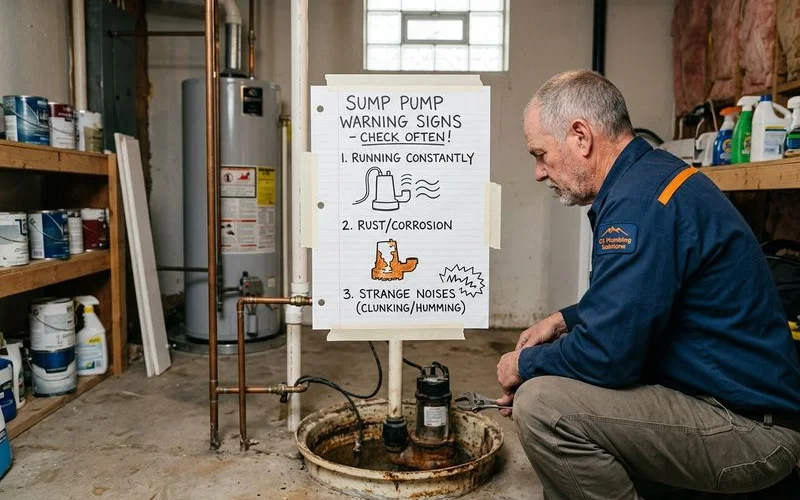
Identifying a problem early requires knowing exactly what to look and listen for. The warning signs below indicate that your system is actively struggling.
Constant running with no water
A pump that runs when the pit is empty usually suffers from a stuck float, a failed check valve, or an electrical issue. This continuous operation will burn out the motor very quickly.
We often find that a broken check valve is the culprit, allowing water to flow back into the pit immediately after being pumped out. Replacing a check valve typically costs between $125 and $200 in 2026, which is much cheaper than replacing a burned-out motor.
Strange noises
Grinding, rattling, or humming without pumping all signal serious mechanical issues inside the unit. These sounds point to worn bearings, a jammed impeller, or a failing motor.
Our technicians frequently pull debris like small rocks or hard water buildup out of jammed impellers. Professional cleaning can save the unit if you catch the noise early, but a loud grinding sound usually means the internal bearings are already destroyed.
No activation when the pit fills
The most dangerous failure occurs when the pit fills with water and the pump just sits there. A tripped GFCI outlet, a dead motor, or a stuck float switch causes this silent threat.
We see tethered float switches get pinned against the side of the basin constantly. Vertical float switches slide straight up and down on a rod, making them far less likely to jam against the pit wall than traditional tethered models. Upgrading to a vertical switch is a quick fix that prevents a major catastrophe.
Visible rust or corrosion
Deep rust, flaking metal, or corrosion around the discharge fittings signals that the structural integrity of the pump is failing. Cast-iron units can handle minor surface rust, but serious flaking means a breach is imminent.
Our recommendation is to inspect the base of the unit closely. Heavy cast-iron pumps, like the popular Zoeller M53, are built to resist corrosion much better than cheaper sheet-metal or plastic alternatives. Investing in a cast-iron model extends the lifespan of the equipment significantly.
Age beyond 7 to 10 years
Submersible pumps generally last 5 to 10 years, while pedestal models can survive 10 to 15 years. Past this typical lifespan, you should plan a replacement before the next storm season arrives.
We advise replacing any plastic-housed pump that is older than five years. The constant submersion and water pressure wear down the seals and bearings much faster on these entry-level units. Proactive replacement is always cheaper than cleaning up water damage.
Vibration or movement during operation
A pump that shifts inside the pit during operation suffers from a mounting or alignment issue. This excessive movement wears out the internal components rapidly and risks unplugging the power cord.
Our crews always secure the discharge pipe firmly to the basement wall to prevent this vibration. Unsecured pipes allow the torque of the motor to twist the entire unit, which can easily wedge the float switch against the basin wall.
A discharge that does not flow
If the motor runs but no water exits the discharge line, the pipe is likely clogged, frozen solid in winter, or experiencing an airlock. A failed check valve can also block the flow entirely.
We always verify that there is a small, 3/16-inch “weep hole” in the discharge pipe just above the pump to prevent airlock. If this tiny hole gets clogged with debris, the trapped air will prevent the impeller from moving any water out of the pit. Cleaning the weep hole with a wire is a simple maintenance trick that restores flow instantly.
How to test it
Performing a routine sump pump test is the easiest way to protect your property. Testing your equipment takes only a few minutes and requires no special tools.
The bucket test
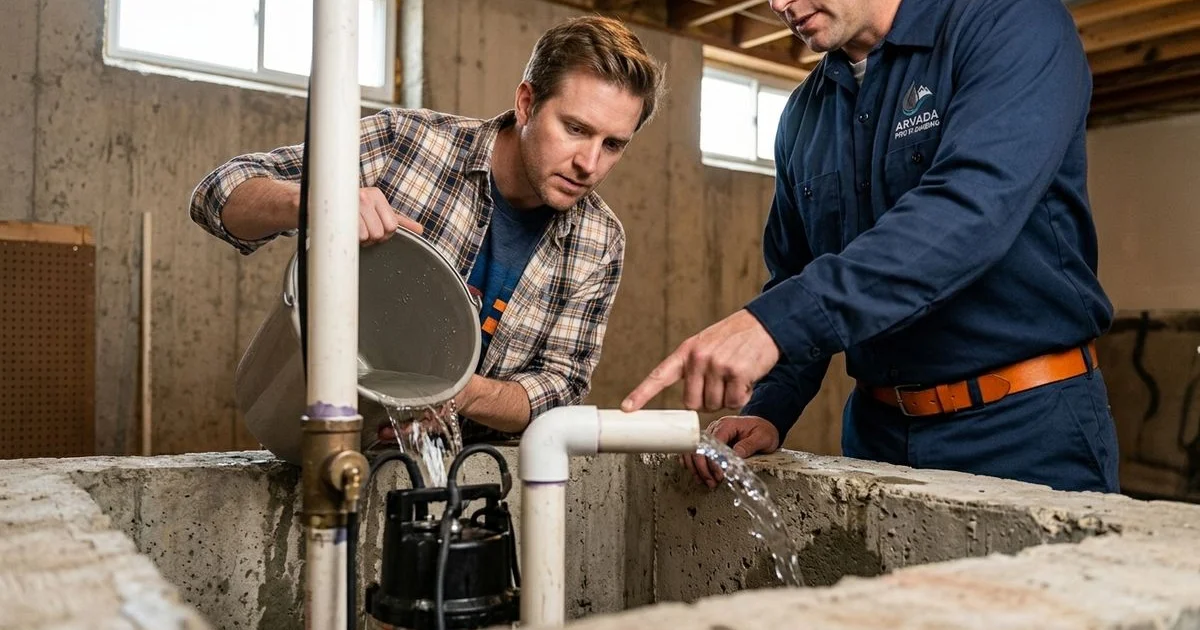
The bucket method simulates a real rain event to ensure the float switch and motor work together correctly.
We recommend performing this test right before the heavy spring rains hit Arvada. Follow these steps for an accurate reading:
- Remove the basin lid and clear away any visible cobwebs or debris.
- Slowly pour 5 gallons of clean water directly into the pit.
- Watch the float switch rise and listen for the motor to engage.
- Verify that the water actively drains out of the discharge pipe.
- Ensure the motor shuts off cleanly once the water level drops.
A system that fails to activate or struggles to drain the basin has a mechanical problem that requires attention.
The electrical outlet test
Power supply issues are incredibly common, so verifying the electrical connection is a mandatory step.
Our technicians frequently discover that a tripped Ground Fault Circuit Interrupter (GFCI) outlet is the main reason behind a sump pump not working. You can verify the electrical status quickly:
- Unplug the power cord completely from the wall outlet.
- Press the “Reset” button on the GFCI outlet if one is present.
- Plug the cord back in securely.
- Listen for the unit to briefly cycle on and off.
A system that remains completely silent after a power reset has a dead motor or a severed internal connection.
The battery backup question
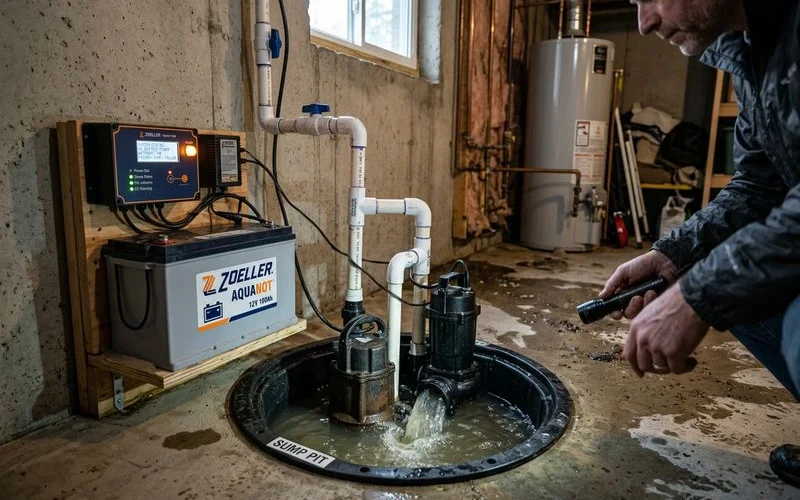
The single biggest failure mode in Colorado is a perfectly healthy unit that simply has no electricity. Severe storms routinely knock out the local power grid right when basements are most vulnerable to flooding.
We consider a battery backup system mandatory for any home with a finished lower level. A secondary unit runs on a dedicated marine battery whenever the main power drops out. High-quality backup models, like the Liberty 441 or the Zoeller Aquanot, provide roughly 4 to 5.5 hours of continuous pumping. Because a pump only cycles on for a few seconds at a time, that continuous runtime easily translates to a full day of protection during intermittent rain. Operating without a backup leaves your property completely exposed to unpredictable weather.
Our comprehensive sump pumps for Colorado basements guide covers these secondary systems in much greater detail. Reviewing those options will help you make an informed decision for your property. To understand the real-world value of these systems, look at the typical capacity of a high-end 12-volt backup battery:
| Pumping Condition | Estimated Battery Lifespan | Common Scenario |
|---|---|---|
| Continuous Pumping | 4 to 7 hours | Severe flash flooding with no pauses. |
| Intermittent Cycling | 1 to 3 days | Standard spring rainstorms. |
This table clarifies how a backup unit buys you critical time to ride out an electrical outage.
Annual maintenance is cheap insurance
A brief maintenance routine is the most cost-effective way to prevent water damage. Setting aside 20 minutes in early spring prepares your equipment for the heavy snowmelt.
We advise performing the following physical inspection steps every single year:
- Run a live bucket test: Pour water directly into the basin to verify the float switch engages properly.
- Listen to the motor: Pay attention to any grinding or humming noises that suggest worn bearings.
- Inspect the discharge line: Look closely for exterior kinks, internal blockages, or ice buildup at the exit point.
- Check the hardware: Scan the iron housing for deep rust and confirm the unit has not shifted off its base.
- Test the backup system: Disconnect the main power cord to force the battery unit to activate.
- Clear the pit debris: Remove any silt, gravel, or sludge from the bottom of the basin to protect the impeller.
Ignoring minor irregularities during this inspection often leads to total mechanical failure later.
Our technicians strongly recommend scheduling a professional service call immediately if your system struggles with any of these basic tasks. Taking action early keeps your repair costs manageable.
When to replace vs. repair
Deciding between a quick fix and a total replacement depends entirely on the age and condition of your equipment. Labor and parts for a minor repair average between $150 and $350 in 2026, so pouring money into a dying motor rarely makes financial sense. Use these general guidelines to make a smart, cost-effective choice:
- Under 5 years old with a single issue: Repairing a stuck float or clearing a blocked impeller is a wise investment.
- Under 8 years old with motor noise: Monitor the system closely or replace it defensively before it fails completely.
- Over 8 to 10 years old with warning signs: Replace the unit immediately, as the internal seals are likely degrading.
- Plastic housing over 5 years old: Upgrade proactively to a durable cast-iron model to prevent housing cracks.
We generally see new pump installations in the Arvada area running between $500 and $1,200, depending heavily on the pump quality and the inclusion of a battery backup. Installing a premium submersible model typically lands closer to the $800 to $1,600 range. Spending that money upfront is a tiny fraction of the $10,000 or more it costs to remediate a flooded finished basement.
Our team is ready to evaluate your system and help you secure your property against water damage. Recognizing the signs your sump pump is failing early gives you the power to act. Call us today to schedule a comprehensive inspection before the next heavy storm arrives.