
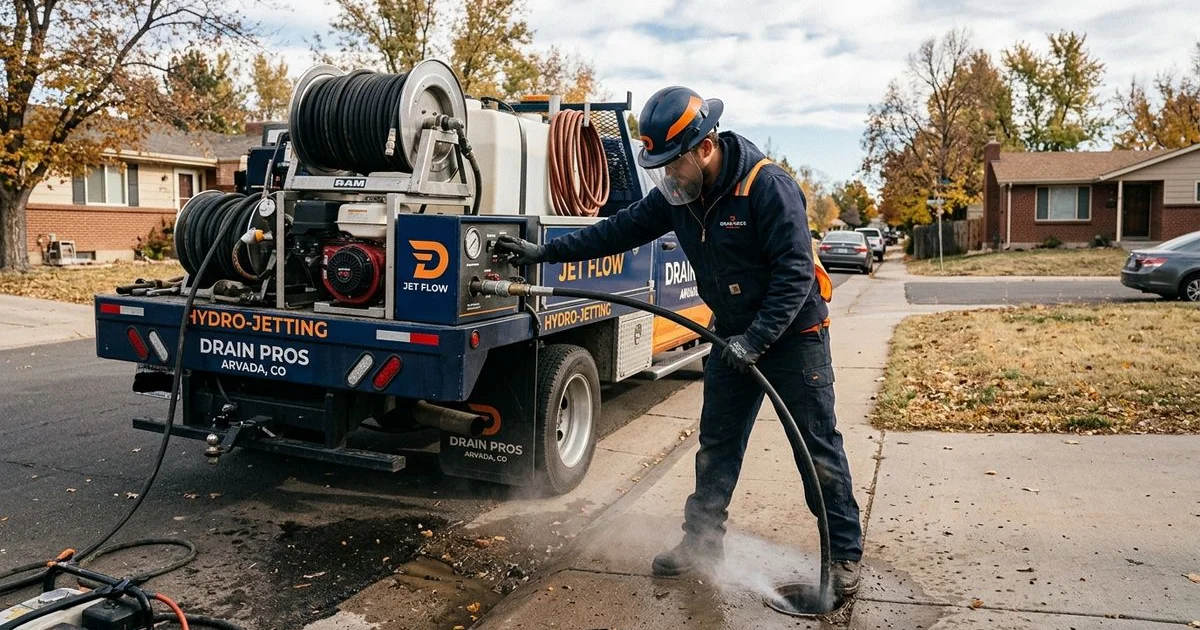
You know how frustrating it is when a kitchen sink backs up on a holiday weekend. A simple drain snake often leaves a sticky grease coating behind in your pipes. We understand that pain, because Arvada Pro Plumbing has cleared thousands of stubborn clogs across Colorado.
Understanding what is hydro jetting provides a much better solution for long-term flow. Let’s look at the hard data, what the equipment actually does, and then explore practical ways to respond to stubborn clogs. Our team relies on this high-pressure technology to scour pipes completely clean.
A short definition: what is hydro jetting?
Hydro jetting is a professional plumbing technique that blasts high-pressure water through a drain or sewer line via a specialized nozzle. Think of it as a commercial pressure washer built specifically for the inside of your plumbing system. Our industry uses this method to scrub the entire inside of the pipe clean instead of just punching a small hole through a clog.
The final result is a pipe wall completely cleared of stubborn grease, mineral scale, and recurring buildup. Standard 2026 industry data shows most residential cleaning jobs range from $350 to $600. We know that thorough scrub is what makes hydro jetting the right call for serious blockages.
Paying that upfront cost often prevents much more expensive pipe replacements down the road.
High water pressure provides a permanent fix rather than a temporary patch.
Our experience proves this saves homeowners significant money over time.
How the process works
A powerful truck or trailer-mounted unit pumps water during the sewer jetting process at carefully controlled pressure levels through a heavy-duty hose. The standard pressure for residential lines sits between 1,500 and 4,000 PSI, while commercial restaurant lines might require up to 5,000 PSI. We always adjust this pressure based on the age and material of your specific pipes.
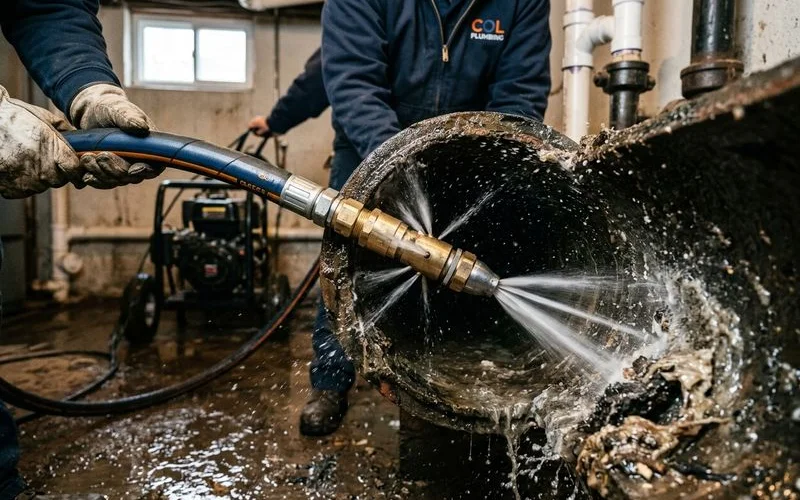
At the end of that heavy hose, a specialized nozzle does all the heavy lifting. Plumbers often use a Warthog nozzle, which combines high pressure with a massive 3 to 8 Gallons Per Minute flow rate to flush debris away. Our technicians rely on the nozzle to navigate safely through the dark pipe.
Most jetting nozzles feature three main components:
- Rear-facing jets that propel the nozzle through the pipe like a jet ski in reverse.
- Forward-facing jets that break up clogs and debris ahead of the tool.
- Side-facing jets that scour the circular pipe walls completely clean.
The plumber feeds this hose into an exterior access point called a cleanout. We watch as the nozzle works its way through the underground line, scrubbing the walls clean as it moves. The broken-down sludge washes away completely so it never enters the city main. Regular snaking cannot achieve this level of deep cleaning. Our high-pressure equipment makes sure the pipe stays clear for years.
What jetting removes
High-pressure water tackles an entirely different category of pipe blockage than a traditional mechanical cable. This advanced cleaning process handles several tough materials:
- Grease buildup: The most common reason for service calls in residential kitchens and commercial restaurants.
- Mineral scale: Hard water leaves calcium deposits that shrink the inside of your pipes.
- Soap and detergent residue: Laundry lines often choke on thick soap scum.
- Tree root intrusion: Fine roots from common local trees sneak into old clay pipes looking for water.
- General sludge: Decades of organic waste naturally accumulate in older plumbing systems.
Our cleaning tools physically wash away sticky substances that a standard auger would simply slide right through. Older homes in Arvada built before 1970 often have clay pipes that are highly vulnerable to root invasions. Targeted water streams completely obliterate these light to moderate root masses. We see root masses trap toilet paper and grease, which quickly creates a total blockage.
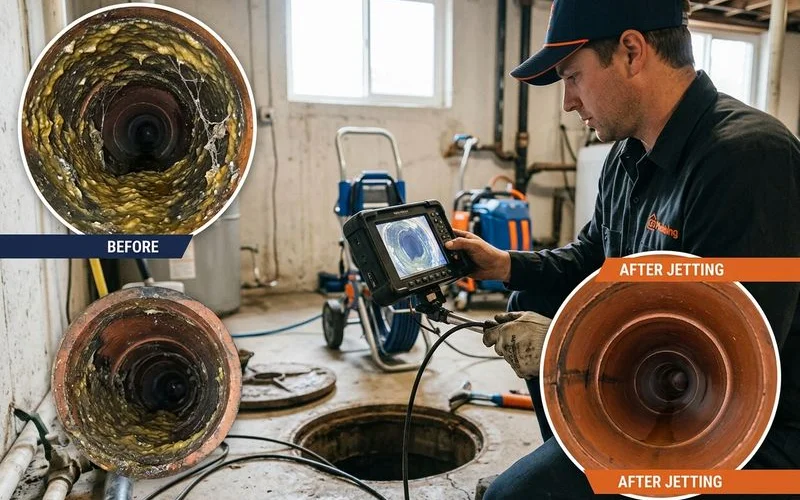
Mineral scale from hard water also restricts flow over time. Thick soap and detergent residue hardens like concrete in laundry lines. Our process blasts all of this debris into the main sewer system safely.
Why camera inspection comes first
A professional plumber will never blast high-pressure water into a line blindly. Modern technology like the industry-standard RIDGID SeeSnake camera transmits live, high-definition video directly to a monitor above ground. We know the same intense pressure that scours a healthy pipe clean will easily shatter a line that is cracked, severely corroded, or collapsing.
This 1080p footage reveals the exact condition of the underground infrastructure. A camera showing a fragile PVC line means the pressure must stay below 3,000 PSI. Our pre-service camera inspection tells us four vital pieces of information:
- Whether the pipe structure can safely handle 4,000 PSI of full pressure.
- Where the thickest grease or root buildup is heavily concentrated.
- What specific kind of physical blockage we are dealing with today.
- Whether high-pressure water alone will solve the issue or whether other mechanical work is needed.
Seeing a totally collapsed cast iron pipe means jetting will not work at all. The camera takes the guesswork completely out of the diagnosis. We adjust the pressure, switch to a different approach, or recommend a structural repair before turning on any water.
What to expect during the service
A typical residential cleaning appointment follows a strict, safety-first workflow. The entire process ensures your home stays clean while the underground mess is blasted away. Our crews arrive fully equipped to handle everything from minor kitchen backups to main sewer emergencies.
- Setup: Protective gear is placed, drop cloths cover your floors if working inside, and the heavy equipment is positioned safely.
- Camera inspection: The waterproof lens scopes the line to identify the exact issue and confirm it is structurally safe to clean.
- High-pressure jetting: The nozzle works its way through the line, violently scouring the dirty walls while the motor runs outside.
- Re-inspection: The camera goes back underground to visually confirm the line is spotless and full water flow is restored.
- Cleanup: The team leaves the cleanout access point sanitized and fully packed up.
A standard residential appointment usually takes between 1 and 3 hours to complete. Large commercial restaurant lines often require more time due to heavy grease loads. We recommend checking out our comprehensive snaking vs. jetting guide to see a direct comparison of these two distinct methods.
Comparing the two main methods
Seeing the numbers side-by-side helps clarify which service fits your specific plumbing crisis. Traditional snaking punches a small hole, while water pressure restores the entire pipe diameter. Our team put together this quick breakdown to help you make an informed decision.
| Feature | Traditional Snaking | High-Pressure Jetting |
|---|---|---|
| Best For | Soft clogs, hair, single items | Grease, scale, tree roots, sludge |
| Cleaning Method | Mechanical metal auger | 1,500 to 4,000 PSI water stream |
| Result | Restores basic water flow | Cleans pipe to original diameter |
| Average 2026 Cost | $150 to $250 | $350 to $600 |
When jetting is the right call
Choosing this powerful service makes the most sense when traditional methods keep failing. If you find yourself calling a plumber every few months for the same slow drain, the pipe walls need a deep scrub. We highly recommend this advanced service, because having hydro jetting explained properly provides long-term peace of mind.
High-pressure water is the smartest approach when:
- A main line keeps backing up despite repeated snaking attempts.
- The interior pipe walls are heavily coated with sticky grease or hard calcium scale.
- You manage a commercial kitchen or a restaurant grease trap line.
- Light root intrusion is clearly present, but the pipe is otherwise structurally sound.
- You want longer-lasting results that prevent future plumbing emergencies.
Severe damage changes the equation completely. Our plumbers will always stop and recommend a physical pipe repair first in those dangerous situations. If the inspection reveals a fragile, crushed, or fully collapsed line, water pressure is not the answer. The condition of the pipe always dictates the right repair method. Our goal is to fix the underlying problem permanently.
Taking care of a clogged pipe quickly prevents messy sewage backups inside your living space. Now that you understand what is hydro jetting, you can make a much smarter decision about your property maintenance. We are ready to answer your questions and get your plumbing system running perfectly again.
Contact your local drain experts today to schedule a camera inspection and see exactly what is hiding in your pipes. Clean pipes protect the value of your entire property. Our trucks are stocked and ready to help.