
You know how stressful a slow drain feels when you cannot see the actual blockage.
We understand that blind guessing often leads to expensive mistakes for Arvada homeowners. The reality is that undetected underground damage averages around $7,500 in local repair costs.
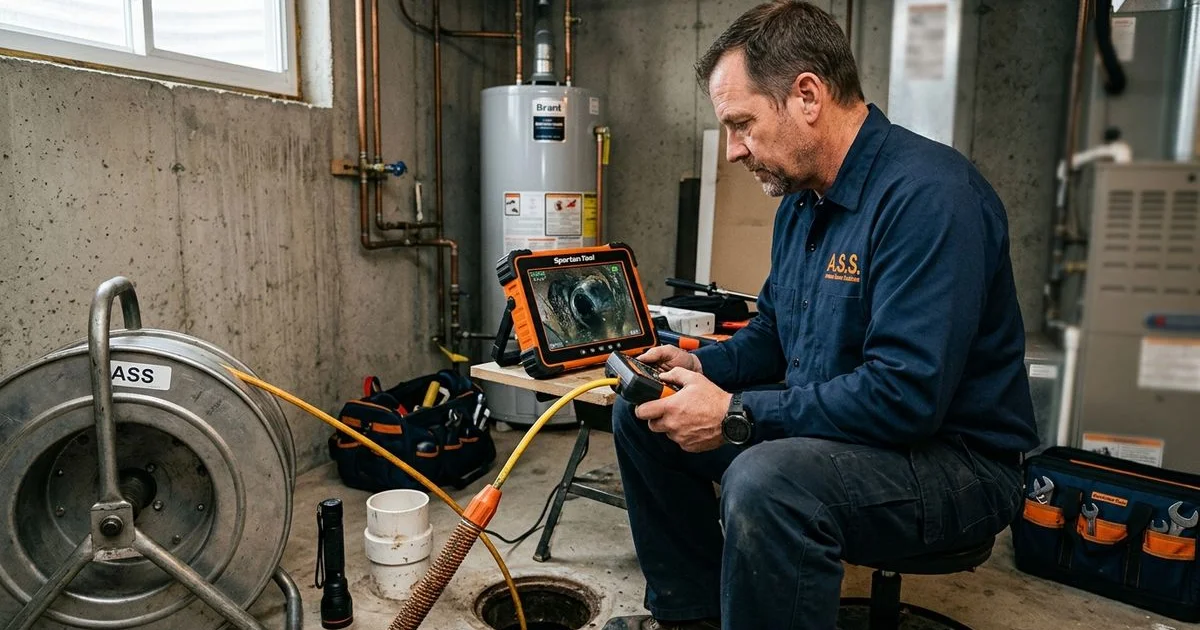
Our team relies on a sewer camera inspection to eliminate that diagnostic uncertainty entirely. When asked what does a sewer camera inspection show, we tell customers it reveals the exact condition of your underground pipes.
What does a sewer camera inspection show underground?
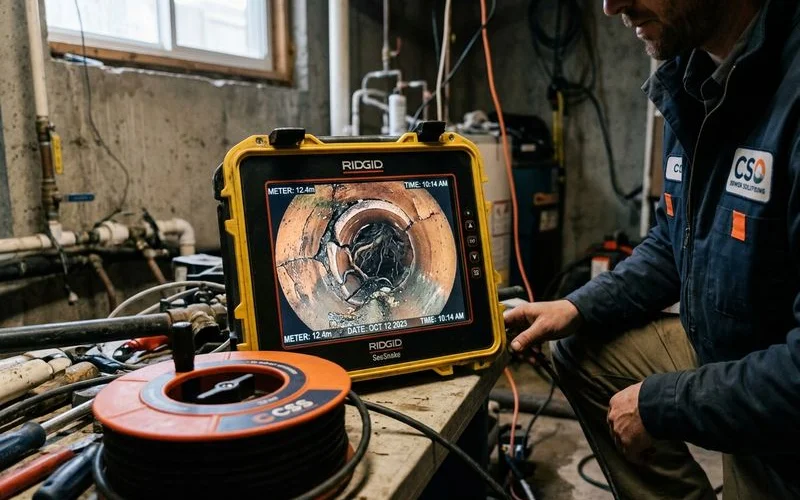
A video pipe inspection sends a professional-grade push rod down your cleanout. We typically use advanced systems like the RIDGID SeeSnake equipped with digital self-leveling technology. This high-definition equipment transmits live, upright footage directly to a monitor in real time. Our plumbers watch the inside of the pipe inch by inch to find the exact problem.
What you see is the actual, current condition of your underground line. You no longer have to guess about a fix based solely on surface symptoms. We use this direct visual evidence to plan the most accurate repair possible.
What the camera typically reveals
Blockages and clogs
The camera shows exactly where a clog sits in the pipe. We can see immediately if the blockage is made of grease, scale, flushable wipes, or foreign objects. Knowing the material composition directly guides which clearing method to use. Our technicians might choose a simple cable auger for paper, but heavy grease requires high-pressure hydro jetting.
Root intrusion
Tree roots are one of the most common findings in older Arvada plumbing lines. We frequently see invasive roots from Cottonwoods and Siberian elms wreaking havoc underground. Colorado clay soil shifts during dry spells, creating tiny cracks that release moisture into the ground. Our inspections reveal how roots travel up to 100 feet to penetrate these vulnerable pipe joints.
The video shows exactly how thick the root mass is and whether the surrounding pipe wall remains intact.
Cracks and breaks
A hairline crack or a fully broken pipe becomes completely visible on the screen. We evaluate the severity of the fracture to determine if it threatens the structural integrity of your system. The specific location and size of the break drive the final repair recommendation. Our goal is to catch these fractures before they turn into a total collapse.
Joint separation
Older clay and cast iron lines feature hub-and-spigot or bell joints. Years of ground movement often cause these connections to separate. We use the camera to clearly display the gap where wastewater is seeping out into your yard. This clear visual allows teams to see if the pipe can be patched without major digging. Our plumbers always look for the least invasive repair option first.
Bellies (sag in the line)
A belly is a low spot where the pipeline sags below the proper, gravity-fed slope. We look for areas where water and solid waste collect, which inevitably leads to recurring clogs. The live footage shows the pooled water and helps calculate the exact depth of the sag. Our plumbers use this measurement to propose a targeted correction.
Collapsed sections
Partial or full pipe collapse stops the inspection immediately. We cannot push the camera past a section of pipe that has completely caved in. The exact stop point tells the plumber exactly where the structural failure begins. Our crews use this dead-end marker to map out the emergency excavation zone.
Pipe material and approximate age
The camera reveals the exact material makeup of your system. We inspect lines made of clay, cast iron, PVC, or ABS plastic daily. Mid-century Arvada neighborhoods also frequently hide Orangeburg pipe, a tar-and-fiber material used heavily from the 1940s through the 1970s. Our technicians know that Orangeburg absorbs moisture and eventually flattens under pressure, meaning it requires immediate replacement.
Here is a quick breakdown of what different materials mean for your property.
| Pipe Material | Era Common | Typical Issues Found on Camera |
|---|---|---|
| Clay | Pre-1980s | Root intrusion at joints, cracking |
| Cast Iron | Pre-1970s | Bottom channeling, heavy rust scale |
| Orangeburg | 1940s - 1970s | Blistering, flattening, total collapse |
| PVC / ABS | 1980s - Present | Bellies, poor installation angles |
We use these historical material facts to predict future maintenance needs.
General condition
Beyond specific structural failures, the camera highlights the complete condition of the system. We analyze the interior walls for heavy scaling, deep scratches, corrosion, and general smoothness of flow.
Locating the issue precisely
Knowing there is a problem at around 40 feet from the cleanout is simply not enough information for a repair. We need pinpoint accuracy to avoid destroying your landscaping unnecessarily. Modern sewer cameras carry a 512Hz sonde transmitter embedded right behind the camera head. Our experts use a handheld digital locator above ground to pick up this signal through dirt and concrete.
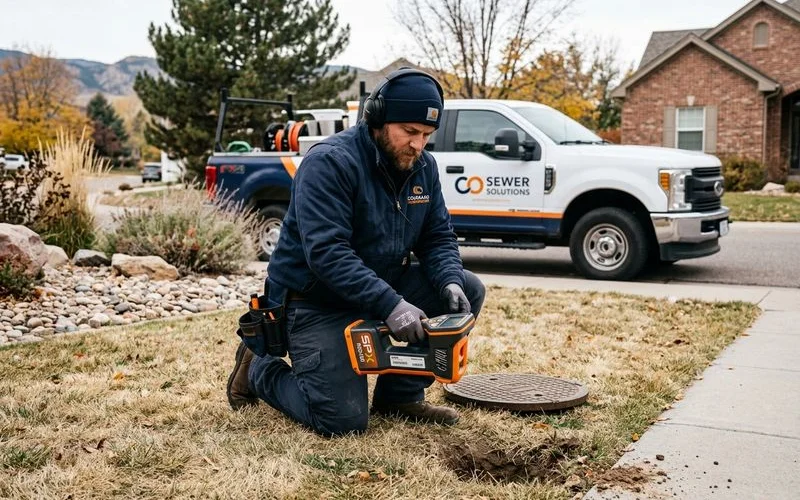
This advanced tracking gives exact coordinates and depth for the damage. We use this precise data to plan a much smaller excavation hole. It is also the critical first step for planning trenchless sewer repair methods like Cured-In-Place Pipe (CIPP) lining. Our trenchless solutions save you from tearing up your entire driveway or prized garden.
What you receive
After a sewer scope inspection concludes, you should expect a comprehensive breakdown of the results. We provide every homeowner with a clear, actionable package.
This typically includes:
- The live walkthrough with the plumber narrating what they see on screen.
- A digital video clip or high-resolution photos of the specific findings.
- A written summary noting issue types, precise locations, and recommended next steps.
- An upfront estimate for any necessary repair work.
If you are buying a home, your home inspector or real estate agent will likely want this footage. We gladly share these files because the video belongs to you. For more details on the best time to schedule this service, please see our when to get a sewer scope guide.
Why the cost is usually worth it
A professional video inspection runs roughly $150 to $450 in the Arvada and Denver metro areas. We consider this to be one of the smartest, lowest-risk plumbing investments a homeowner can make.
Compared to the nightmare of buying a house and inheriting a $15,000 hidden sewer replacement, a few hundred dollars is an absolute bargain.
Our team is ready to help you uncover what is really going on underground. Understanding what does a sewer camera inspection show gives you the power to fix minor issues before they become massive disasters.
We invite you to call us today to schedule your pipeline assessment.