
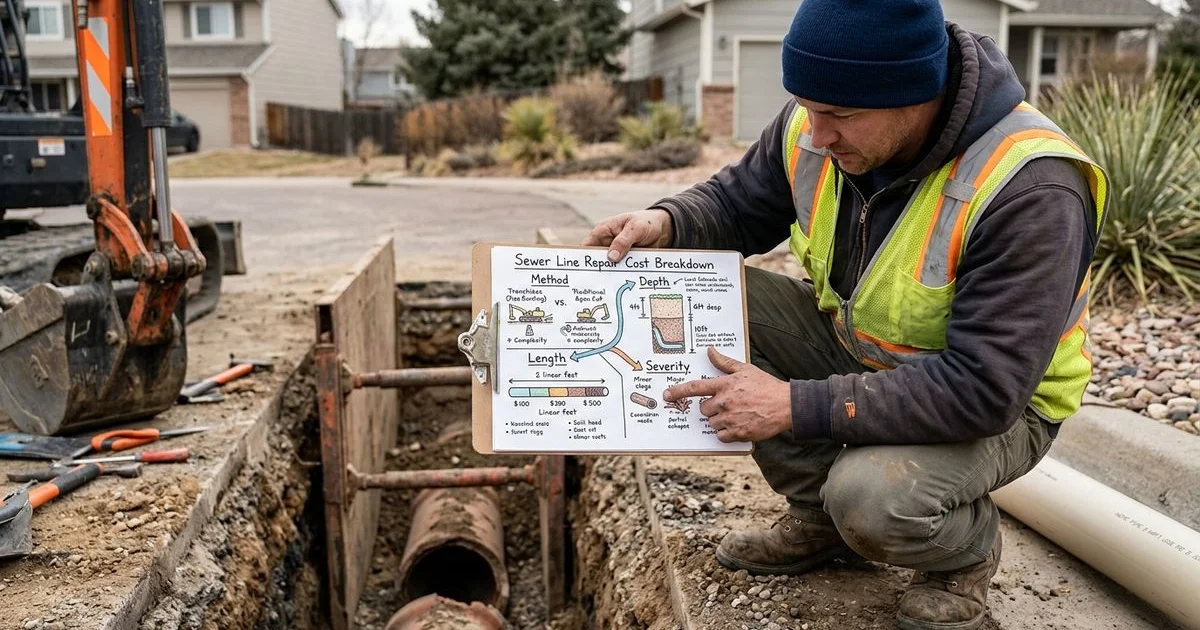
Our team fields calls every single day from Arvada homeowners looking for a flat sewer line repair cost colorado estimate over the phone.
This urge to find a quick number is completely understandable, but a sight-unseen quote is rarely accurate. The Front Range has unique soil conditions and aging infrastructure that make every sewer line repair project entirely different.
We built Arvada Pro Plumbing to provide dependable service, and our years of experience tell us exactly what hides beneath the local surface. Expansive bentonite clay soil regularly shifts and crushes older cast iron pipes. Thirsty tree roots from local cottonwoods and elms also seek moisture during dry spells, breaking into vulnerable joints.
Our goal today is to help you make sense of the actual prices and the variables behind them. Let’s look at the data driving these estimates, what it is actually telling us, and explore a few practical ways to respond.
Why sewer repair costs vary so much
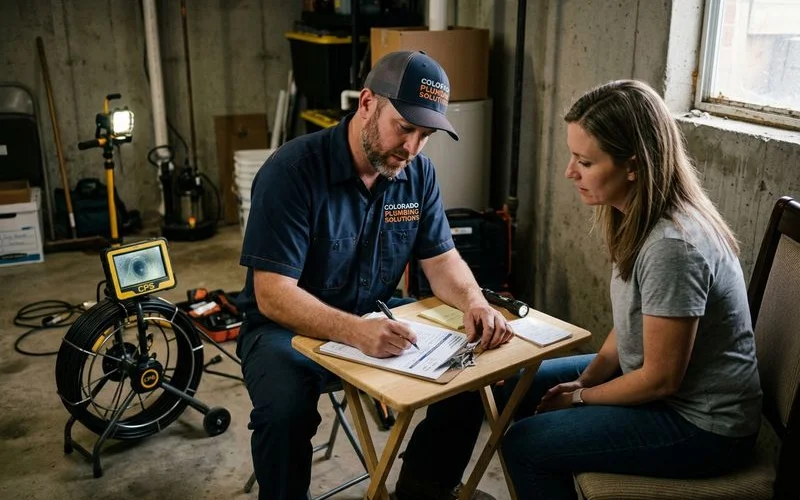
A localized crack three feet down in soft dirt is a fundamentally different job from a collapsed line eight feet under a concrete driveway. We always start with a camera inspection because it provides the exact diagnostic data required for a realistic quote. This process is never a stalling tactic. Knowing the precise location and severity of the damage is the only way to avoid surprise charges later.
Our technicians frequently find that older neighborhoods in Arvada still rely on clay or cast iron pipes installed before the 1970s. These materials deteriorate in predictable ways, making them highly susceptible to the freeze-thaw cycles of Colorado winters. The camera footage tells the exact story of what material is buried and what repair method makes sense.
Realistic cost ranges in Colorado
We provide these typical pricing ranges for residential work in the Denver and Arvada area as a helpful baseline. Your written estimate is the only final price that truly counts. The actual sewer line repair price will fluctuate based on the specific depth and length of your damaged pipe.
| Scope | Typical range |
|---|---|
| Spot repair, shallow line (3-5 ft) | $1,500 - $3,500 |
| Spot repair, deeper line (6-10 ft) | $3,000 - $6,000 |
| Trenchless pipe lining (CIPP), full residential line | $6,000 - $15,000 |
| Pipe bursting (full replacement, no-dig) | $7,000 - $18,000 |
| Full excavation replacement (residential) | $5,000 - $20,000 |
| Sewer camera inspection only | $200 - $450 |
Our customers often experience initial shock when looking at trenchless options, but those numbers require context. Trenchless technology, like Cured-In-Place Pipe (CIPP) lining, generally costs between $80 and $250 per linear foot. You easily recoup that initial investment by avoiding the massive expense of rebuilding a concrete driveway or replacing mature landscaping. We highly recommend these no-dig methods because traditional excavation destroys your yard and adds thousands in hidden restoration fees.
What drives the price up or down
Several specific variables determine exactly what your final bill will look like. Every property presents unique challenges that directly influence the total sewer replacement cost colorado homeowners pay. We evaluate each of these factors during our initial inspection to give you a precise breakdown.
Depth and Length of Damage
Every foot deeper means more excavation, required safety shoring, and longer work hours. A four-foot line is materially cheaper to reach than a nine-foot line buried under compacted soil. We carefully measure the exact length of the damaged section, because a six-foot patch is fundamentally different from a 60-foot complete run.
The total price scales roughly linearly with the amount of pipe that needs replacement or lining. Pipes running under an open lawn are relatively easy and inexpensive to access. Our estimators always factor in the required above-ground labor, because a pipe buried under a concrete driveway or a custom deck costs significantly more.
Access and Method Choice
Removing and replacing hardscaping is incredibly time-consuming. Working around established structures requires specialized equipment and careful planning. We handle all required municipal applications for you, saving you the headache of managing city paperwork.
The City of Arvada requires specific permits for wet utility work on private property and in the right-of-way. If your repair requires digging into a city street, Arvada enforces a Street Cut Moratorium that triggers degradation fees starting at $20.50 per linear foot of trench. We clearly outline these municipal fees and restoration expenses in our estimates so you understand the true scope of the project.
Final Yard Restoration
Restoring your property back to its original condition is a major cost driver that many cheap quotes ignore. Laying new sod, pouring fresh concrete, and fixing broken irrigation lines add up quickly. Our team ensures a complex routing path is fully accounted for in your initial quote, avoiding surprise landscaping bills at the end.
How to budget realistically
A smart financial plan is essential, especially if you own an older Arvada home built before 1980. Early detection limits the repair scope and cost, while delays often turn a simple cleaning into a full system replacement. We recommend following a structured approach to protect your property and your wallet.
- 1. Get a baseline camera inspection to start. Spending $200 to $450 the very first time you experience slow drains or gurgling toilets is the smartest money you can spend. We advise clients that this footage serves as a verifiable baseline you can compare against years later to monitor slow-moving root intrusion.
- 2. Secure a detailed written estimate from a professional. Verbal quotes hold zero weight when dealing with complex underground plumbing. We provide free, comprehensive written estimates on all repair projects to guarantee total transparency.
- 3. Compare options on total cost rather than just the pipe. Focusing solely on the per-foot cost of the material is a common pitfall. We remind clients to add the cost of hardscape restoration, daily disruption, and potential downtime into their final calculation.
- 4. Ask your plumber about flexible financing. Many local homeowners choose to pay for major sewer work over time rather than draining their savings. We gladly refer our customers to trusted financing partners to make the process as stress-free as possible. Breaking up the payments helps significantly with timing and long-term budget management.
When the cheaper option is the wrong call
Accepting the absolute lowest bid is extremely risky when dealing with critical sanitation infrastructure. We urge homeowners to be incredibly wary of a quote if it presents any of the following red flags.
- Missing video evidence: Never accept a diagnosis if it does not include raw camera footage you have viewed with your own eyes.
- Excluded municipal permits: Shady contractors will skip pulling the required Arvada right-of-way permits to make their price look lower.
- We want you to remember that omitted restoration costs hide the true price, leaving you with a shattered walkway.
- Symptom-only fixes: Frequent snaking or root clearing only addresses the symptom, allowing the underlying cracks or sags to grow worse over time.
A structural repair done correctly the first time is mathematically cheaper than paying for three rounds of partial, emergency fixes. We have seen far too many homeowners waste thousands of dollars on repeated drain snaking when a localized patch would have solved the problem permanently. These temporary fixes only buy you a few months of relief before the sewage backs up again.
For a deeper look at the trade-offs between specific repair methods, see our detailed trenchless vs. excavation comparison. We are ready to dispatch a camera crew today to give you the honest, accurate answers you deserve. Do not wait for a complete pipe collapse to take action and secure your property.